Why industrial property keeps outperforming everything else in South Africa
South African industrial property has been the best-performing commercial asset class for four straight years, and the 2026 numbers suggest it has more room to run.
The summary for people who only read the first paragraph
South African industrial property has been the best-performing commercial asset class for four straight years, and the 2026 numbers suggest it has more room to run. Vacancy rates near four per cent, rental growth above eight per cent, and a pipeline constrained by construction cost inflation. For tenants this means fewer options and higher rents. For developers with land in the right nodes it means sustained demand. And for investors it means the industrial cycle is not done, even if the easy wins are behind us.
The headline numbers
Start with the data. National industrial vacancy sits at around 3.8 per cent, below the long-term average of 4.2 per cent and well below office and residential vacancy. Nominal rental growth for the 500 m² benchmark size hit 8.4 per cent year-on-year in the third quarter of 2025, with 1 000 m² units recording similar growth of roughly 8 per cent. Rentals are approximately 31 per cent above pre-pandemic 2019 levels.
Source: Rode Report Q3 2025, summarised at mendace.co.za.
For context, those figures make industrial property the clear outperformer in the commercial universe. Offices continue to recover from their structural oversupply, with vacancy still well above the long-run average and rental growth patchy. Retail is solid in dominant centres and weak outside them. Industrial is the only sector where vacancy is below its long-run average and rental growth comfortably outpaces construction cost inflation in some nodes.
What is driving the demand
The honest answer is e-commerce, not manufacturing.
South African manufacturing has been soft for most of the past three years. The Absa Purchasing Managers' Index stayed below the 50-point expansion threshold through most of 2025, averaging 43.9 points in the fourth quarter before a small recovery in early 2026. Output in the first eight months of 2025 contracted by 1.8 per cent.
Source: Absa PMI, Bureau for Economic Research, cited in Rode Report Q3 and Q4 2025.
Despite that, industrial demand kept climbing. The reason is that retail is still moving through a fundamental shift. South African online retail sales have been growing at double-digit rates for five years running, which forces retailers, third-party logistics providers and last-mile operators to keep adding warehousing capacity. Distribution centres, particularly bespoke logistics warehouses over 20 000 m², have been the tightest segment of the market.
The pattern is echoed in the capital flows. Listed landlords like Growthpoint and SA Corporate have been quietly rotating portfolios out of older manufacturing-linked assets and into logistics-grade facilities. The REIT sector in aggregate is now materially lighter on manufacturing stock than it was five years ago.
Why the supply response has been slow
There are three reasons that new industrial stock has not flooded the market in response to low vacancy.
The first is land. The best-located industrial land in Gauteng, near the Aerotropolis corridor, along the N1 through Midrand and Louwlardia, and in the Pomona to Kramerville belt, has been largely consumed. New greenfield sites are harder to secure and often require rezoning, servicing and infrastructure contributions that stretch timelines by 18 to 36 months.
The second is construction cost inflation. The Bureau for Economic Research's Building Cost Index has been running close to 10 per cent a year for most of the post-Covid period. That has compressed development margins and made speculative developments harder to pencil. Investors require a minimum net income yield of around 9.3 per cent on prime industrial leaseback properties with top-tier covenants, assuming contractual escalations near 7 per cent.
Source: Rode Report Q4 2025 industrial market review.
The third is tenant expectations. Modern logistics tenants want P-grade specification, solar-ready roofs, strong yard depths, modern dock configurations and fibre infrastructure from day one. That raises the real cost per square metre of new development and tilts the economics toward pre-let or build-to-suit deals rather than speculative multi-tenant parks.
Where the growth is concentrated
Geography still matters a great deal.
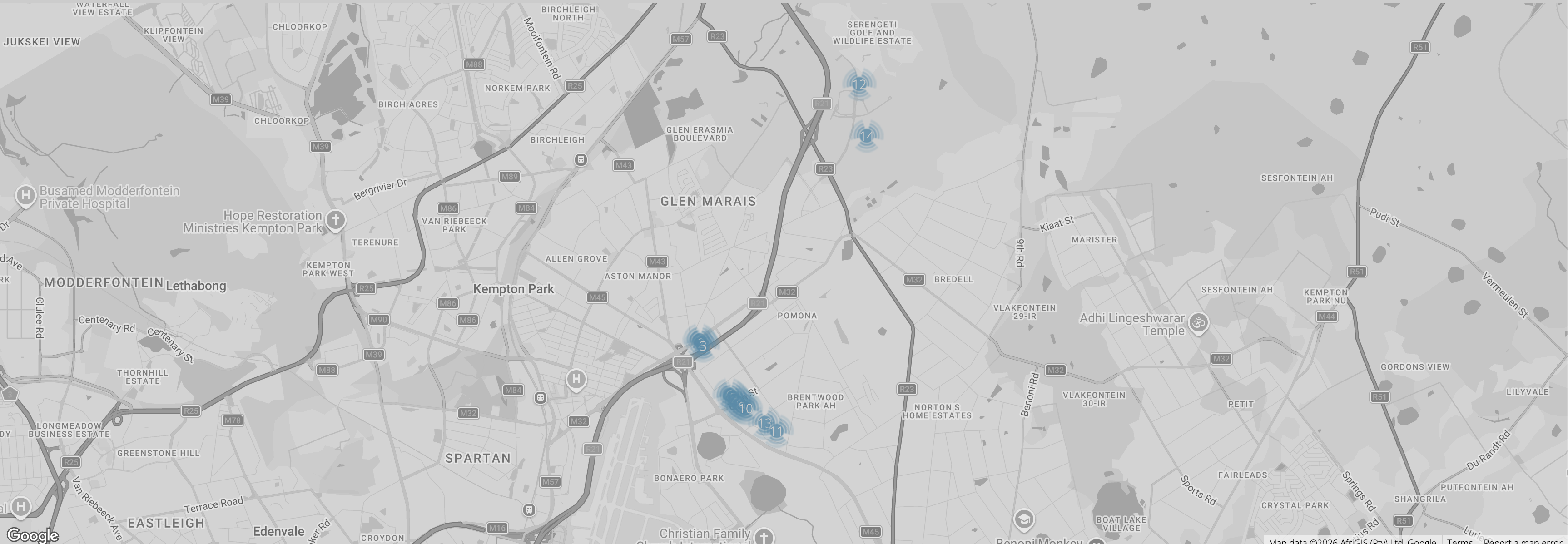
Cape Town remains the tightest industrial market in the country, with double-digit rental growth through parts of 2025 and vacancy around 3.5 per cent. Durban continues to recover from the lingering effects of the 2021 civil unrest and the 2022 floods, with nominal growth around 7 per cent in 2024.
In Gauteng the market is more nuanced. Central Witwatersrand saw the fastest regional rental growth at 10.9 per cent in Q3 2024, the only major region where rental growth outpaced construction cost inflation. Vacancy in Central Witwatersrand dropped to 3 per cent.
Source: Rode Report Q3 2024, Mendace Properties summary.
The East Rand, which includes the R21 Aerotropolis corridor and the Pomona industrial belt, continues to benefit from proximity to OR Tambo International Airport and access to the N1, N12 and N3.
The outlook into 2027
Industrial property is unlikely to repeat the eye-catching rental growth numbers of 2025 indefinitely. The 8 per cent plus nominal growth will probably moderate as new supply comes online, particularly from the pipeline of developments that broke ground in 2024 and 2025 and will complete through 2026 and 2027.
However, the structural story remains intact. E-commerce penetration in South Africa is still well below developed-market levels, which means the tailwind on logistics demand has not played out. Interest rates are gently easing, which supports cap rate compression and transaction activity. And the limited supply of prime-location industrial land means that well-located parks will continue to command premium rents for the foreseeable future.
Industrial will not be the most exciting asset class in 2027. It will be the most reliable. For tenants, brokers, developers and investors that is the whole point.
Quick reference: South African industrial property, key metrics at a glance
| Metric | Latest value | Source |
|---|---|---|
| National industrial vacancy | 3.8 per cent | Rode Q3 2025 |
| Long-term average vacancy | 4.2 per cent | Rode |
| Nominal rental growth, 500 m² | 8.4 per cent y/y | Rode Q3 2025 |
| Nominal rental growth, 1 000 m² | approx 8 per cent y/y | Rode Q3 2025 |
| Rentals vs pre-pandemic 2019 | +31 per cent | Rode Q3 2025 |
| Required yield, prime leaseback | 9.3 per cent minimum | Rode Q4 2025 |
| Building Cost Index inflation | approx 10 per cent y/y | BER BCI |
| Cape Town vacancy | 3.5 per cent average 2024 | Rode |
| Central Witwatersrand vacancy | 3 per cent | Rode Q3 2024 |