Inside the Aerotropolis corridor: Why the R21 belt keeps pulling logistics capital
The R21 corridor between Kempton Park and Pretoria is quietly becoming one of the most important logistics addresses in Southern Africa.
The summary
The R21 corridor between Kempton Park and Pretoria is quietly becoming one of the most important logistics addresses in Southern Africa. It is anchored by OR Tambo International Airport, structured by the Ekurhuleni Aerotropolis Master Plan, and populated by some of the largest warehousing, freight and cold-chain operators on the continent. For tenants the question is not whether to consider the corridor. It is which node inside the corridor fits the use case. This piece maps the geography, the economics and the practical differences between the main industrial sub-nodes.
What is an Aerotropolis and why is ours built around OR Tambo
An Aerotropolis is a metropolitan region designed so that its economy, land use and infrastructure centre on an airport. The concept was popularised by John Kasarda of the University of North Carolina, and it frames how global airport-adjacent economies, from Memphis to Incheon, have grown around freight and passenger flows.
In South Africa the Ekurhuleni Aerotropolis Master Plan was approved in 2017 and covers a 30-year horizon through to 2047. OR Tambo International Airport sits at the centre. The airport handles 83 per cent of all air cargo movements in the country and is the largest airport in Africa by passenger volume.
Source: Kempton Express, Global Africa Network, City of Ekurhuleni Aerotropolis documentation.
The master plan segments the Aerotropolis into concentric zones. Just-in-time logistics, warehousing, cool-chain storage and single-tenant distribution are prioritised within a five-minute radius of the airport. Larger manufacturing, research and development, and retail hubs extend outward along the R21, R23, R24, R25 and N12. Key implementation projects already underway include the Riverfields Development, the OR Tambo Special Development Zone, the Plumbago Industrial Park, the Gibela Rail Manufacturing Plant and the Ekurhuleni Integrated Rapid Public Transport Network.
The corridor economics
The reason the R21 corridor matters to property economics is straightforward. Transport cost is the single largest variable cost in most logistics businesses. Every kilometre between a distribution centre and its origin or destination point adds fuel, labour and time.
OR Tambo's Aerotropolis sits at the intersection of three major national logistics flows. The airport handles the high-value, time-sensitive freight. The R21 links to the N1 and on to the Gauteng manufacturing belt. The R23 links east into Ekurhuleni's established industrial base. The R24 and R25 link south into Germiston and into the eastern N3 corridor that runs to Durban. And the broader Gauteng road network connects the Aerotropolis to 60 per cent of South Africa's GDP within a 60-minute truck journey.
For a logistics tenant, locating in the R21 corridor means compressing the distance-cost on nearly every shipment. That is why the market has been willing to absorb rental premiums in the node even through soft periods in the broader economy.
Mapping the main sub-nodes
The R21 corridor is not a single market. Inside it, four sub-nodes have their own distinct tenant profile, rental band and supply characteristics.
Pomona and Chloorkop
The original industrial heart of Ekurhuleni. Streets like Elgin, Deodar, Sarel Baard and Maple host established warehousing and light-industrial parks. Pomona is where tenants go when they want infrastructure that has been bedded in for a decade or more, where brokers know every landlord, and where P-grade refurbishment is a faster path to occupation than greenfield development. KLD's 40 Deodar Street, 127 Elgin Street and 50 Maple Street developments sit in this belt. Rental growth in the East Rand industrial belt has lifted materially since 2022, though vacancy remains the lowest in Gauteng's prime industrial sub-nodes.
Riverfields Precinct and Witfontein
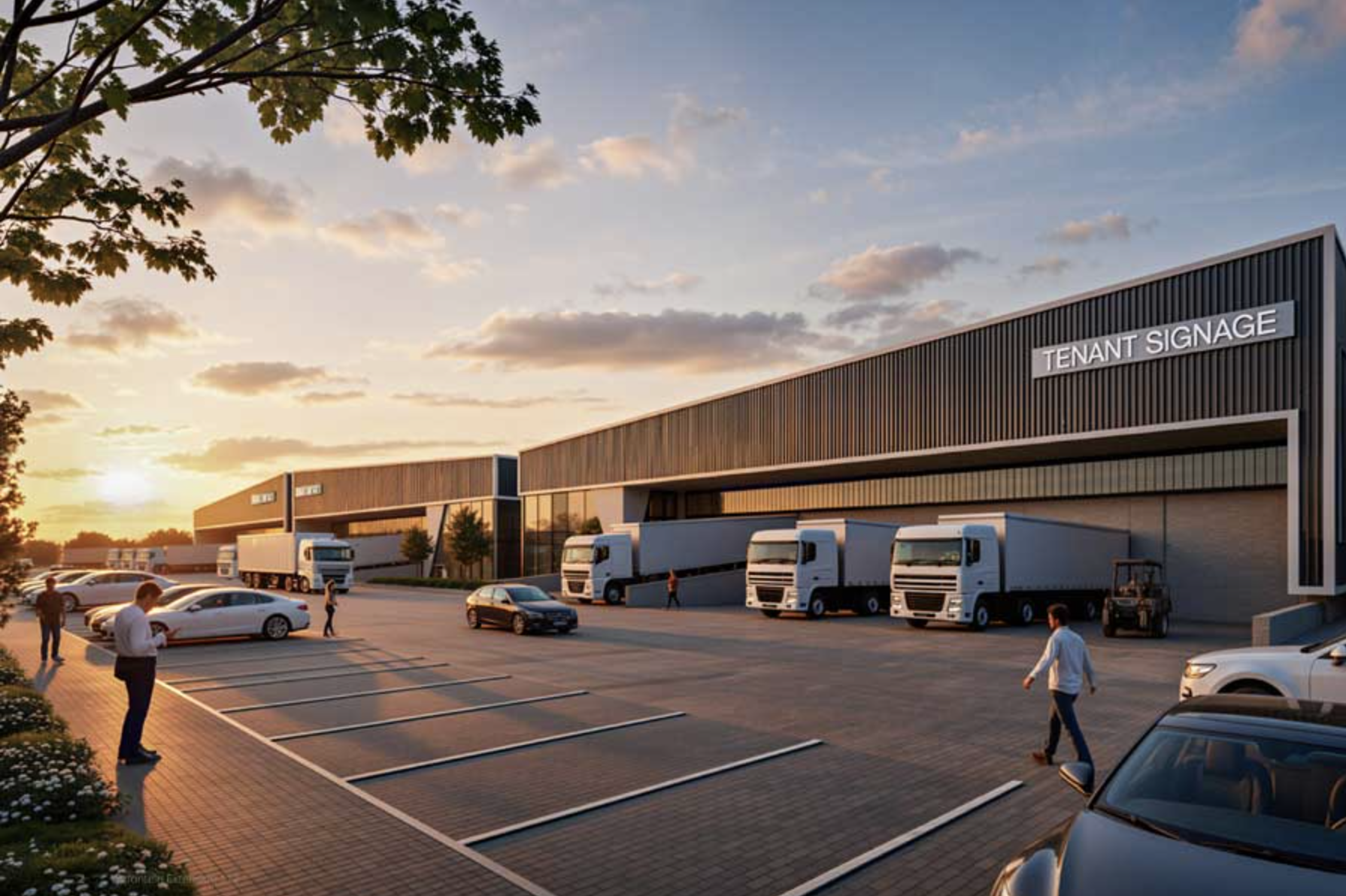
The newest major industrial node on the R21. Riverfields is positioned as a mixed-use precinct with residential, retail and business park components developed in concert. It benefits from direct R21 access, proximity to the R23 and R25 interchanges, and a frontage onto the planned extension of the R25 northern interchange. Riverfields is also the site of the KLD and Moolman Group joint venture, Riverfield Business Park North and South, with the South park (X112) as its flagship. The precinct is 12 km from OR Tambo, which is a meaningful drive-time saving over the deeper East Rand.
Kempton Park industrial
Closer to the airport itself. Home to larger single-tenant facilities for airfreight forwarders and distribution operators. Land here is scarcer and mostly consumed. New supply comes through redevelopment of older stock rather than greenfield, which limits the pipeline.
Great North Road and Glen Marais
Further north, along the R21 toward Pretoria, with the Gibela rail manufacturing plant as an anchor. The area has attracted mid-scale logistics tenants looking for good R21 access at lower rentals than Pomona. KLD's KLD Logistics Hub 2 and X190 KL Logistics Park developments sit in this belt.
Why tenants still pay a premium to be here
The obvious reason is OR Tambo. Any business moving air-cargo volumes needs to be within a short drive of the airport, and the R21 corridor is the shortest drive for most of it.
The less obvious reason is the cluster effect. Once a node attracts enough operators in a given sector, the sector starts to depend on the node. That is why Pomona has become such a hub for freight forwarders, and why Witfontein is turning into a polymer and manufacturing cluster. Scan Global Logistics, Brenntag, Plasson, Jungheinrich and Mann+Hummel are all KLD tenants in this corridor, and each of their supply chains is easier to run precisely because their suppliers, customers and service providers are also nearby.
That cluster effect is self-reinforcing. New tenants move into the corridor because the incumbents did. Developers with land in the corridor benefit, and the node tightens further.
What brokers say
Brokers who work the R21 corridor report two consistent patterns. First, tenants are searching earlier than they used to. Leases that previously turned over in a three-month window now turn over in a six to nine-month window, because tenants are not willing to risk a gap between leases in a market this tight. Second, broker-led deals are increasingly replaced by pre-letting, where a tenant locks in a unit directly with a developer before the development is formally on the market.
Both patterns favour developers with active tenant relationships. Which is the main reason KLD, Moolman Group and the other established corridor developers continue to see strong take-up on new phases before they complete.
Risks and watch-items
No market is without risk. The three worth watching in the R21 corridor are infrastructure, power and municipal service delivery.
Infrastructure upgrades on the R21 and the interchanges that feed it have lagged the pace of development. The City of Ekurhuleni has a 100-kilometre road improvement programme as part of the Aerotropolis master plan, but execution has been uneven. Tenants locating in Riverfields and Witfontein should factor in access constraints during peak hours until the interchange upgrades complete.
Power is the second watch-item. Eskom's supply situation has improved materially since 2023, and grid capacity in Ekurhuleni is generally adequate for new industrial load. But tenants should still ask developers explicitly about kVA allocations, backup infrastructure and solar-readiness at the project-specific level, because individual feeders can differ substantially even within the same node.
Municipal service delivery is the third. Water reliability, road maintenance and waste collection have been uneven across Ekurhuleni. The best-run business parks, including most of the KLD portfolio, invest in on-site infrastructure to buffer tenants from municipal variability.
The long arc
The Aerotropolis master plan runs to 2047. The City of Ekurhuleni's own modelling suggests the plan could result in an estimated 581 000 new jobs over its horizon, anchored by logistics, advanced manufacturing, aerospace and airport-related services. That is the scale of the regional economic bet being made around OR Tambo.
Source: Global Africa Network, Ekurhuleni Aerotropolis Vision.
For tenants, brokers and developers, the practical implication is that the R21 corridor is not a short-term cycle. It is a multi-decade land-use shift. The developments completing in 2026 and 2027 are infrastructure for a logistics economy that will be materially larger in 2040 than it is today.
The developers who are still getting new sites entitled and built today are the ones who will be quietly dominant when that 2040 economy arrives.