Green warehousing after the energy crunch: What P-grade actually means in 2026
South Africa's energy transition is reshaping what a serious industrial tenant expects from a warehouse.
The summary
South Africa's energy transition is reshaping what a serious industrial tenant expects from a warehouse. Solar-ready roofs are standard, battery storage is increasingly common, and the IRP 2025 has set a trajectory that makes self-generation economically rational for most logistics operators. This piece unpacks what P-grade specification looks like in practice in 2026, why the energy layer now sits at the heart of it, and how developers can design for a grid that will look very different by 2030.
The price of electricity changed everything
The single largest driver of the green warehouse has been electricity economics. Between 2008 and 2023, South African electricity tariffs rose roughly 720 per cent. Over the same period, general consumer inflation totalled 215 per cent.
Source: Centre for Renewable and Sustainable Energy Studies (CRSES), Stellenbosch University.
For an industrial tenant, the implication is that electricity that accounted for 3 to 5 per cent of total operating cost in 2010 now accounts for 8 to 12 per cent for many logistics operators and significantly more for cold-chain, manufacturing and chemical tenants. Load-shedding added a volatility premium on top of that. Diesel generators, once a backup item, became a line of the monthly operating budget. None of that was sustainable.
The response, from 2019 onward, was self-generation. The easing of licensing thresholds, first to 1 MW and then removed entirely for generation for own use, turned solar PV from a niche choice into a default. By the end of 2025, behind-the-meter solar installations across South Africa totalled several gigawatts, with industrial users among the largest installers.
Source: CRSES installed capacity tracking, SolarQuarter market reporting.
Large-scale examples are multiplying. NCP Chlorchem, a major chlorine producer supplying South Africa's water treatment sector, started with a 1.1 MWp pilot in 2023 under the old licensing cap, expanded to roughly 11 MWp across rooftop, carport and ground-mounted systems, and is completing a further 17.5 MWp to reach 27 MWp in total. That is at a single industrial site.
Source: CleanTechnica reporting on NCP Chlorchem and Terra Firma, December 2025.
The IRP 2025 and what it means for tenants
The Integrated Resource Plan 2025, approved in late 2025, sets South Africa's electricity mix trajectory to 2039. The headline numbers are significant. The plan envisages procurement of 34 GW of wind, 25 GW of solar PV, 8.5 GW of battery storage, 16 GW of distributed generation and 5.2 GW of new nuclear capacity by 2039. Total investment is projected at R2.23 trillion over ten to fifteen years, largely funded through independent power producer procurement and power purchase agreements.
Source: Pinsent Masons analysis of IRP 2025, December 2025.
For industrial tenants, three practical implications flow from this. First, the grid itself will become steadily greener over the coming decade as coal plants decommission and renewables scale. Second, private offtake will grow, meaning that industrial users will increasingly be able to contract renewable power directly from independent producers through wheeling arrangements rather than self-generation alone. Third, battery storage will become more common, both behind-the-meter at industrial sites and grid-scale.
New products are already moving in this direction. Discovery Green and Sasol launched Ampli Energy in May 2025 as a month-to-month renewable energy product for South African businesses of all sizes, with no upfront capital cost and flexible cancellation. Ampli's first tranche was fully subscribed within months, with customers including Nando's, NetFlorist, Hatfield Motors and Sealand Gear.
Source: Sasol media release, 15 May 2025.
What P-grade means in 2026
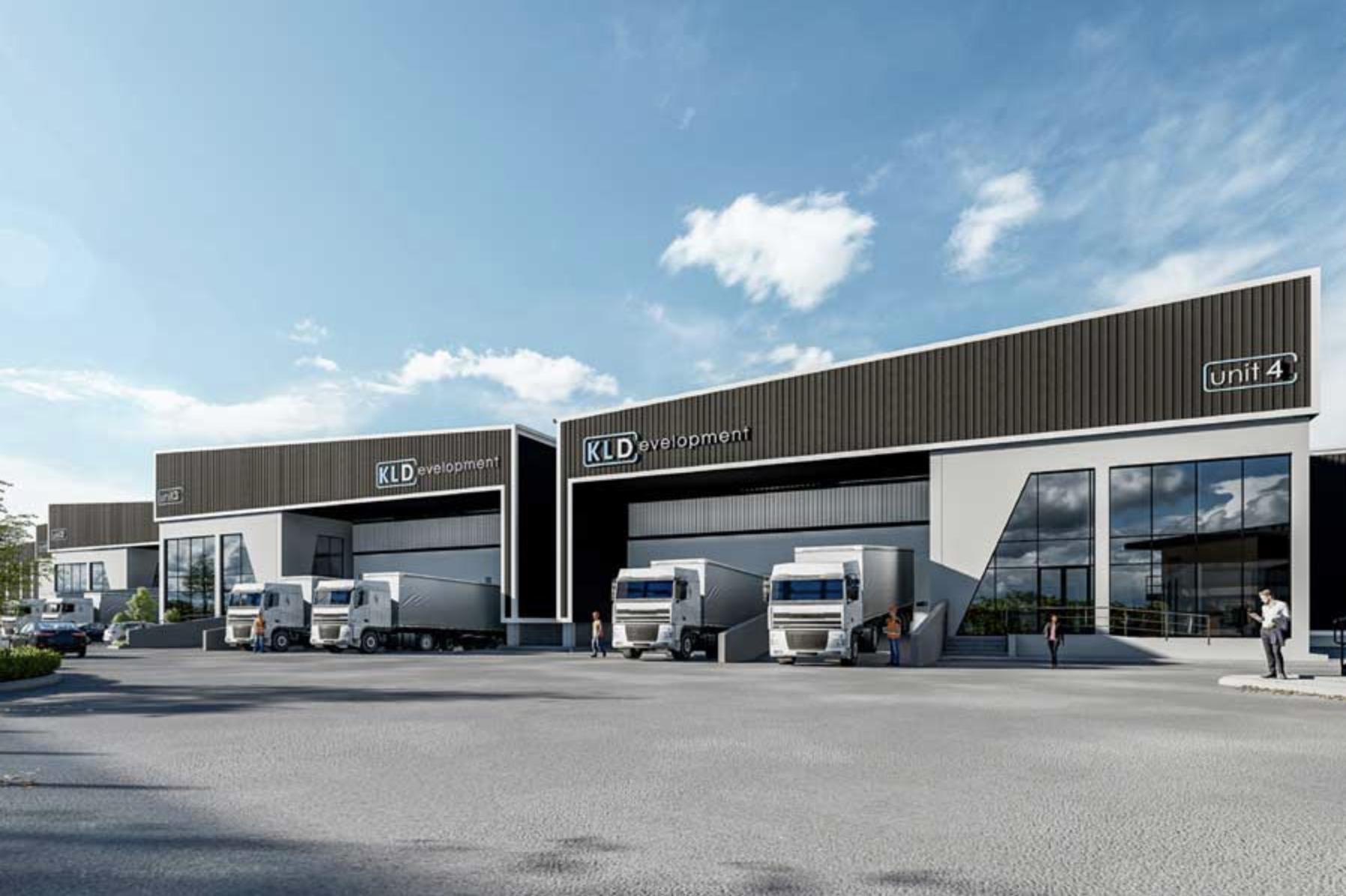
The industry term P-grade, sometimes written Prime or A-grade, describes industrial specification that meets or exceeds modern logistics tenant requirements. It has always covered floor loading, clear heights, dock configurations, sprinklers and fire compliance. What has changed, and what a modern P-grade specification now includes, is the energy and sustainability layer.
In 2026 a P-grade warehouse is expected to have the following, at minimum.
- Reinforced roof structures engineered for solar PV load, with pre-installed conduit and distribution points
- Adequate electrical capacity at the incoming supply to support solar inverters and future battery storage
- LED lighting throughout, with daylight sensors and motion detection in warehouse areas
- Insulated roof sheeting and translucent sheets to reduce daytime lighting load
- Rainwater harvesting where site drainage allows, even if initially used only for landscape irrigation
- Grey-water plumbing in office components for future reclamation
- EV charging infrastructure, or provision for it, at employee and visitor parking
- Generator or UPS capacity sized for critical tenant loads
- High-efficiency HVAC in office blocks, with heat recovery where scale permits
- Fibre infrastructure from at least two independent providers
- Secure, well-lit yards with access control designed for articulated vehicles
- Natural ventilation strategies in warehouse envelopes to reduce mechanical cooling demand
The list is longer than it was five years ago. Tenants, particularly international tenants whose parent companies have net-zero commitments, increasingly require developers to demonstrate these features explicitly in marketing documentation and lease agreements.
The business case, not the moral case
The single most useful thing about 2026 is that the business case for green warehousing no longer needs a moral case.
Solar PV on an industrial roof with sufficient demand profile pays back in three to five years in most South African locations. Battery storage payback is longer but shortening quickly as costs drop. LED lighting pays back in under two years. Insulated roofing pays back through reduced cooling load. Rainwater harvesting at smaller scales breaks even through reduced municipal water costs, and at larger scales saves real money during water restrictions.
In other words, a tenant asking a developer for a green warehouse in 2026 is usually asking for a cheaper warehouse to operate, not a more expensive one. The tenants who understand this best are the international ones, where parent-company finance departments have already done the sums.
What this means for developers

For a developer, the implications are practical.
First, design every new development with a fully engineered solar-ready roof. This means not just structural capacity, but conduit runs, distribution board provisions and roof-surface planning that keeps future PV installations clean. The marginal cost at design stage is trivial compared to retrofitting.
Second, specify oversized incoming electrical supply where the utility permits it. A tenant installing solar and storage in year three will need more kVA headroom than a tenant using utility power only.
Third, offer the green features as part of the tenant package, not as extras. International tenants reading the marketing documentation for two competing developments will often choose the one that lists solar-ready roofs, EV charging provision and rainwater harvesting explicitly over the one that does not.
Fourth, track sustainability performance of the finished portfolio. Industrial landlords who can point to energy intensity, water intensity and solar generation data across their portfolios will increasingly win on the tenant experience front, particularly for multinationals.
The outlook
The energy crunch that started with load-shedding and tariff increases has permanently rewired what industrial property needs to be in South Africa. The warehouses built in 2026 will be operated in a grid that looks meaningfully different by 2030, and very different by 2040.
For tenants, the takeaway is to think about operating cost over a 10-year horizon, not a 3-year one. For developers, it is to design buildings that will still be efficient in 2036. For investors, it is to underwrite income with an energy-transition lens, because the warehouses that perform best over the next cycle will be the ones that did the energy thinking up front.
KLD's current P-grade specification, across Riverfield Business Park North and South (X112), X190 KL Logistics Park and the current portfolio in Pomona, is designed with all of the above in mind. Solar-ready, fibre-ready, efficient by design, operated with the tenant experience at the centre.